Within Perception
Can UFO Stories Change What Witnesses Hear?
Recent documentaries, news stories and discussions can make ambiguous noises seem more consistent with familiar UFO encounter narratives.
On this page
- How expectations guide ambiguous perception
- Why publicity can increase reporting activity
- How familiar UFO language enters later accounts
Page outline Jump by section
Introduction
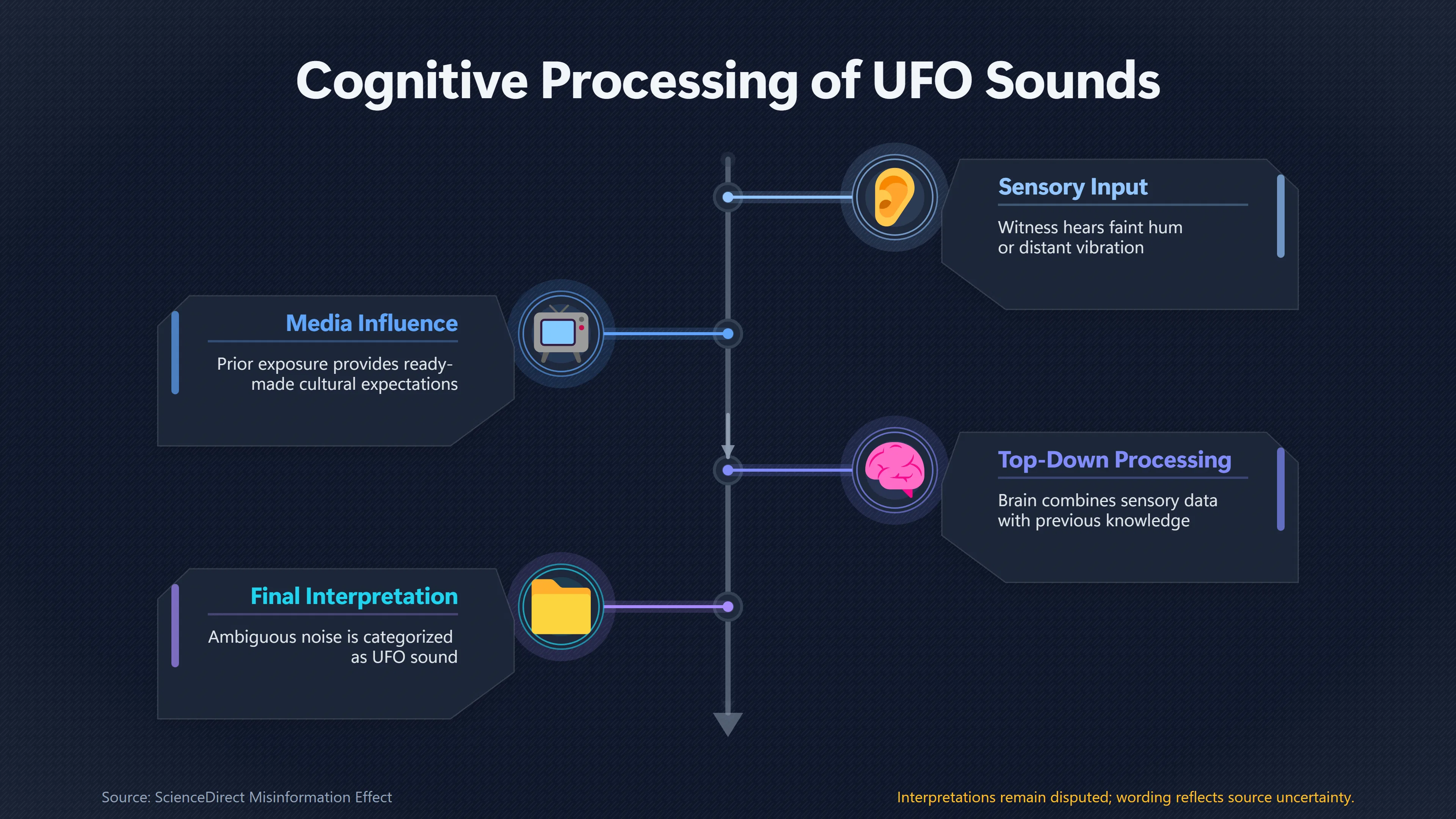
Media coverage of unidentified flying objects (UFOs) and unidentified anomalous phenomena (UAP) can influence how people interpret ambiguous sounds without creating the underlying event itself. When someone hears a distant hum, buzz or vibration while observing an unusual light, prior exposure to documentaries, news reports, films or online discussions can make a UFO explanation feel more immediately plausible than competing explanations. This effect reflects well-established psychological processes involving expectation, top-down perception and reconstructive memory rather than evidence that media generate sightings. Research on perception and eyewitness memory suggests that expectations are particularly influential when sensory information is incomplete or uncertain, making this an important consideration when evaluating reports of alleged UFO noises.[PubMed]pubmed.ncbi.nlm.nih.govTop-down influences on ambiguous perception: the role of stable and transient states of the observer - PubMedDecember 8, 2014…
How expectations guide ambiguous perception
Perception is not a passive recording of the outside world. The brain continually combines incoming sensory information with previous knowledge, beliefs and recent experiences to arrive at the most likely interpretation of an event. This process, known as top-down processing, is especially important when sights or sounds are faint, distant or difficult to identify.[PubMed]pubmed.ncbi.nlm.nih.govTop-down influences on ambiguous perception: the role of stable and transient states of the observer - PubMedDecember 8, 2014…
In the context of UFO reports, media exposure supplies ready-made expectations about what an encounter should sound like. Popular documentaries and dramatised reconstructions often describe mysterious craft as producing:
- A low-frequency hum.
- An electrical buzzing noise.
- A pulsating vibration.
- An unusual silence interrupted by mechanical sounds.
After repeated exposure, these descriptions become familiar reference points. If a person later encounters an unexplained environmental sound while observing an unusual light, those familiar patterns may become the first explanation that comes to mind. This does not mean the witness invents the sound. Rather, expectation influences how an already ambiguous experience is interpreted.[PubMed]pubmed.ncbi.nlm.nih.govTop-down influences on ambiguous perception: the role of stable and transient states of the observer - PubMedDecember 8, 2014…
Importantly, the same ambiguous sound could have been interpreted differently in another cultural or historical setting. Before the modern UFO era, unfamiliar aerial sounds were more likely to be attributed to atmospheric phenomena, secret aircraft or other locally familiar explanations.
Why publicity can increase reporting activity
Periods of intense publicity surrounding UFO stories have long been associated with increases in reported sightings. Researchers studying UFO reporting databases have noted that reporting rates fluctuate alongside major media attention, suggesting that publicity affects whether people decide that an unusual experience is worth reporting and how they categorise it. This pattern is consistent with broader psychological research on attention and expectation rather than serving as evidence that the underlying phenomenon itself has become more common.[PubMed]pubmed.ncbi.nlm.nih.govTop-down influences on ambiguous perception: the role of stable and transient states of the observer - PubMedDecember 8, 2014…
Several mechanisms help explain this relationship.
Greater vigilance. People who have recently watched a high-profile documentary or followed extensive news coverage may become more attentive to unusual lights and unfamiliar environmental sounds that they would normally ignore.
Lower reporting threshold. An experience that previously might have been dismissed as an odd aircraft noise may instead be regarded as potentially significant because similar descriptions have recently appeared in the media.
Shared interpretive framework. Publicity provides common language and expectations that make people more confident that their experience resembles those described by other witnesses.
This helps explain why clusters of reports sometimes follow widely publicised cases even when there is no independent evidence that unusual aerial activity increased during the same period.
How familiar UFO language enters later accounts
Witness statements often evolve over time rather than remaining fixed. Psychological research on eyewitness memory shows that memories are reconstructed whenever they are recalled, making them vulnerable to new information introduced after the original event.[UW Staff]staff.washington.eduUW StaffMisinformation and Memory The Creation of New Memories (1989)March 1, 1989…
For UFO reports, this means that descriptions of sound may gradually become more specific after:
- Watching television programmes about famous UFO encounters.
- Reading articles comparing multiple witness accounts.
- Participating in online discussion forums.
- Talking repeatedly with other witnesses or investigators.
Instead of recalling an uncertain “strange noise”, a witness may later remember an “electrical hum”, “vibrating resonance” or “metallic buzzing” because those labels have become familiar within UFO culture. The change may occur sincerely rather than deliberately, reflecting the normal reconstructive nature of memory.[washington.edu]staff.washington.eduUW StaffMisinformation and Memory The Creation of New Memories (1989)March 1, 1989…
Research on eyewitness testimony also shows that ambiguous events are especially susceptible to schema-driven recall. A schema is a mental framework for understanding familiar situations. When information is incomplete, people naturally fill gaps using the schema that seems to fit best. In experimental settings, participants exposed to ambiguous events are more likely to recall details consistent with an activated schema, even when those details were absent from the original experience.[PubMed]pubmed.ncbi.nlm.nih.govThe influence of schemas, stimulus ambiguity, and interview schedule on eyewitness memory over time - PubMed…
Historical changes in what witnesses report hearing
Descriptions of UFO sounds have not remained constant across decades. Historical collections of reports show that witness language often reflects the technology and cultural imagery of the period.
During the 1950s and 1960s, reports frequently referred to humming discs, jet-like roaring or mechanical whirring, echoing contemporary aviation and industrial technology. Later decades saw more references to electronic buzzing, electromagnetic effects and sophisticated propulsion concepts as these ideas became common in science fiction, documentaries and public discussion.
The broad pattern does not necessarily indicate that witnesses were describing different external phenomena. Instead, it illustrates how available cultural vocabulary provides convenient ways of describing unusual experiences whose acoustic characteristics may have been difficult to identify precisely.
Media influence has limits
The influence of media should not be overstated. Exposure to UFO stories does not automatically produce sightings, nor does it explain every report involving unusual sounds. Many witnesses describe experiences before learning of similar accounts, while others report sounds that bear little resemblance to common UFO narratives.
Psychological evidence instead supports a more limited conclusion: media exposure can alter which interpretation feels most convincing when sensory evidence is uncertain. It may also influence the language used during later recollection, particularly after repeated discussion or prolonged reflection.[PubMed]pubmed.ncbi.nlm.nih.govTop-down influences on ambiguous perception: the role of stable and transient states of the observer - PubMedDecember 8, 2014…
This distinction is important because it separates two different questions:
- Did the witness genuinely experience an unusual sound? Quite possibly.
- Was the sound necessarily produced by the observed object, or remembered exactly as first perceived? That remains much less certain when expectation and later information could have shaped interpretation.
What this means for interpreting UFO sound reports
Understanding media effects does not require dismissing witness testimony. Instead, it encourages separating the original sensory experience from later interpretation. Investigators often gain the clearest information by documenting exactly what a witness heard before discussing famous UFO cases or introducing comparisons with other reports.
Viewed in this way, media influence becomes one factor among several that shape UFO sound reports. It neither proves nor disproves extraordinary claims. Rather, it helps explain why descriptions of ambiguous noises often become more consistent with familiar UFO narratives after periods of publicity, repeated storytelling or exposure to widely recognised encounter accounts.[washington.edu]staff.washington.eduUW StaffMisinformation and Memory The Creation of New Memories (1989)March 1, 1989…
Amazon book picks
Further Reading
Books and field guides related to Can UFO Stories Change What Witnesses Hear?. Use these as the next step if you want deeper reading beyond the article.
The Memory Illusion
THE INTERNATIONAL BESTSELLER 'Truly fascinating.' Steve Wright, BBC Radio 2 - Have you ever forgotten the name of someone you’ve met doze...
The Seven Sins of Memory
Rating: 3.5/5 from 5 Google Books ratings
A New York Times Notable Book: A psychologist's "gripping and thought-provoking" look at how and why our brains sometimes fail us (Steven...
The Invisible Gorilla
NEW YORK TIMES BESTSELLER • Our minds don’t work the way we think they do. Two renowned psychologists explain how and why our intuitions...
eBay marketplace picks
Marketplace Samples
Live-tested eBay searches with available results related to this page.
Selected fromUFO poster oneBay.co.uk.

Current eBay listing
VINTAGE UFO FLYING SAUCERS COMIC ADVERTISING A2 POSTER PRINT

Current eBay listing
I Want To Believe UFO Poster Giclée Fine Art Heavyweight Print


Endnotes
1.
Source: sciencedirect.com
Title: ScienceDirect Misinformation Effect
Link:https://www.sciencedirect.com/topics/psychology/misinformation-effect
Source snippet
Misinformation Effect - an overview | ScienceDirect Topics...
2.
Source: sciencedirect.com
Link:https://www.sciencedirect.com/science/article/pii/S0033350623000835
Source snippet
May 1, 2023 — PUBLIC HEALTH Volume 218, May 2023, Pages 106-113 Themed Paper – Original Research Science communication in th...
Published: May 1, 2023
3.
Source: sciencedirect.com
Title: On the dynamics of reporting data: A case study of UFO sightings
Link:https://www.sciencedirect.com/science/article/pii/S0378437122005295
4.
Source: sciencedirect.com
Link:https://www.sciencedirect.com/science/article/abs/pii/S0006320722001446
5.
Source: sciencedirect.com
Link:https://www.sciencedirect.com/science/article/pii/S2212420922000565
6.
Source: sciencedirect.com
Link:https://www.sciencedirect.com/science/article/pii/S2211368114000230
7.
Source: sciencedirect.com
Title: Misinformation Effect
Link:https://www.sciencedirect.com/topics/neuroscience/misinformation-effect
8.
Source: sciencedirect.com
Title: Misinformation Effect
Link:https://www.sciencedirect.com/topics/social-sciences/misinformation-effect
9.
Source: sciencedirect.com
Title: Media use and US Attitudes Toward Government and Private Space Exploration
Link:https://www.sciencedirect.com/science/article/pii/S0265964622000327
10.
Source: sciencedirect.com
Title: The Public Acquisition of Space Science Information in the 21st Century
Link:https://www.sciencedirect.com/science/article/pii/S0265964622000017
11.
Source: pubmed.ncbi.nlm.nih.gov
Link:https://pubmed.ncbi.nlm.nih.gov/25538601/
Source snippet
Top-down influences on ambiguous perception: the role of stable and transient states of the observer - PubMedDecember 8, 2014...
Published: December 8, 2014
12.
Source: pubmed.ncbi.nlm.nih.gov
Link:https://pubmed.ncbi.nlm.nih.gov/12877270/
Source snippet
The influence of schemas, stimulus ambiguity, and interview schedule on eyewitness memory over time - PubMed...
13.
Source: staff.washington.edu
Link:https://staff.washington.edu/eloftus/Articles/hoff.htm
Source snippet
UW StaffMisinformation and Memory The Creation of New Memories (1989)March 1, 1989...
Published: March 1, 1989
14.
Source: pmc.ncbi.nlm.nih.gov
Link:https://pmc.ncbi.nlm.nih.gov/articles/PMC11680610/
Source snippet
A systematic review - PMCMay 2, 2024 — THEORETICAL APPROACHES TO THE MISINFORMATION EFFECT There are many types of false memories and mem...
Published: May 2, 2024
15.
Source: pubmed.ncbi.nlm.nih.gov
Link:https://pubmed.ncbi.nlm.nih.gov/18158688/
16.
Source: pubmed.ncbi.nlm.nih.gov
Link:https://pubmed.ncbi.nlm.nih.gov/2522502/
17.
Source: researchers.westernsydney.edu.au
Link:https://researchers.westernsydney.edu.au/en/publications/the-effect-of-the-label-%C3%A3%C6%92%C3%A2%C3%A3%C5%A1%C3%A2%C3%A3ufo%C3%A3%C6%92%C3%A2%C3%A3%C5%A1%C3%A2%C3%A3%C3%AF-on-memory-for-ambiguou/
Additional References
18.
Source: psychologicalscience.org
Link:https://www.psychologicalscience.org/journals/current-directions/0963721410396620/
Source snippet
Association for Psychological ScienceCurrent Issues and Advances in Misinformation Research - Current Directions in Psychological Science...
19.
Source: doi.org
Title: The history of an idea: The misinformation effect
Link:https://doi.org/10.1111/lcrp.70020
Source snippet
* Check for updates KEYWORDS * eyewitness * memory * misinformation * testimony PUBLICATION HISTORY * Version of Record online: 24 Decemb...
20.
Source: cambridge.org
Title: De la Torre [Opens in a new window] Show auth
Link:https://www.cambridge.org/core/journals/international-journal-of-astrobiology/article/psychological-aspects-in-unidentified-anomalous-phenomena-uap-witnesses/7D23058E10309384DDAA8E15607485CC
Source snippet
Psychological aspects in unidentified anomalous phenomena (UAP) witnesses | International Journal of Astrobiology | Cambridge CoreDecembe...
21.
Source: youtube.com
Title: How We Make Memories: Crash Course Psychology #13
Link:https://www.youtube.com/watch?v=bSycdIx-C48
Source snippet
Sound design sci fi movies UFO alien sounds Alien 1979 Computer Scene madjestyy...
22.
Source: tandfonline.com
Link:https://www.tandfonline.com/doi/abs/10.1080/01463379809370102
23.
Source: frontiersin.org
Link:https://www.frontiersin.org/journals/psychology/articles/10.3389/fpsyg.2014.01289/full
24.
Source: ovniteca.net
Link:https://www.ovniteca.net/bibliografia/dynamics-reporting-data-case-study-ufo-sightings
25.
Source: cambridge.org
Link:https://www.cambridge.org/core/journals/episteme/article/reevaluating-the-credibility-of-eyewitness-testimony-the-misinformation-effect-and-the-overcritical-juror/B8F651467F46D7D1BCA7F73D46C93FE4
26.
Source: tandfonline.com
Link:https://www.tandfonline.com/doi/abs/10.1080/08934219709367672
27.
Source: research-portal.uu.nl
Link:https://research-portal.uu.nl/en/publications/opposite-influence-of-perceptual-memory-on-initial-and-prolonged-/