Within Low Frequency
Why An Outside Hum Can Seem Inside
Walls, floors and windows can resonate with incoming bass, making an outdoor source appear to come from the ceiling or room itself.
On this page
- How building surfaces vibrate with low frequencies
- Why reflections detach sound from its source
- How to identify standing wave hot spots in a room
Page outline Jump by section
Introduction
A common reason that reported “UFO noises” seem to come from inside a house is that the building itself changes how low-frequency sound is heard. Deep outdoor hums from distant machinery, transport or ventilation systems can cause walls, floors, ceilings and windows to vibrate slightly. At the same time, reflections inside enclosed spaces create standing waves that strengthen the sound in some places and weaken it in others. The result is that an external source can appear to originate from the ceiling, a corner of the room or even from inside the listener’s own home rather than from outdoors. This effect is well understood in architectural acoustics and helps explain why the location of a persistent low-frequency hum can be surprisingly difficult to identify.[Aalto University's research portal]research.aalto.fiAalto University's research portalThe Impact of Standing Waves on Localization Ability of Low-Frequency Sound Sources - Aalto University'…
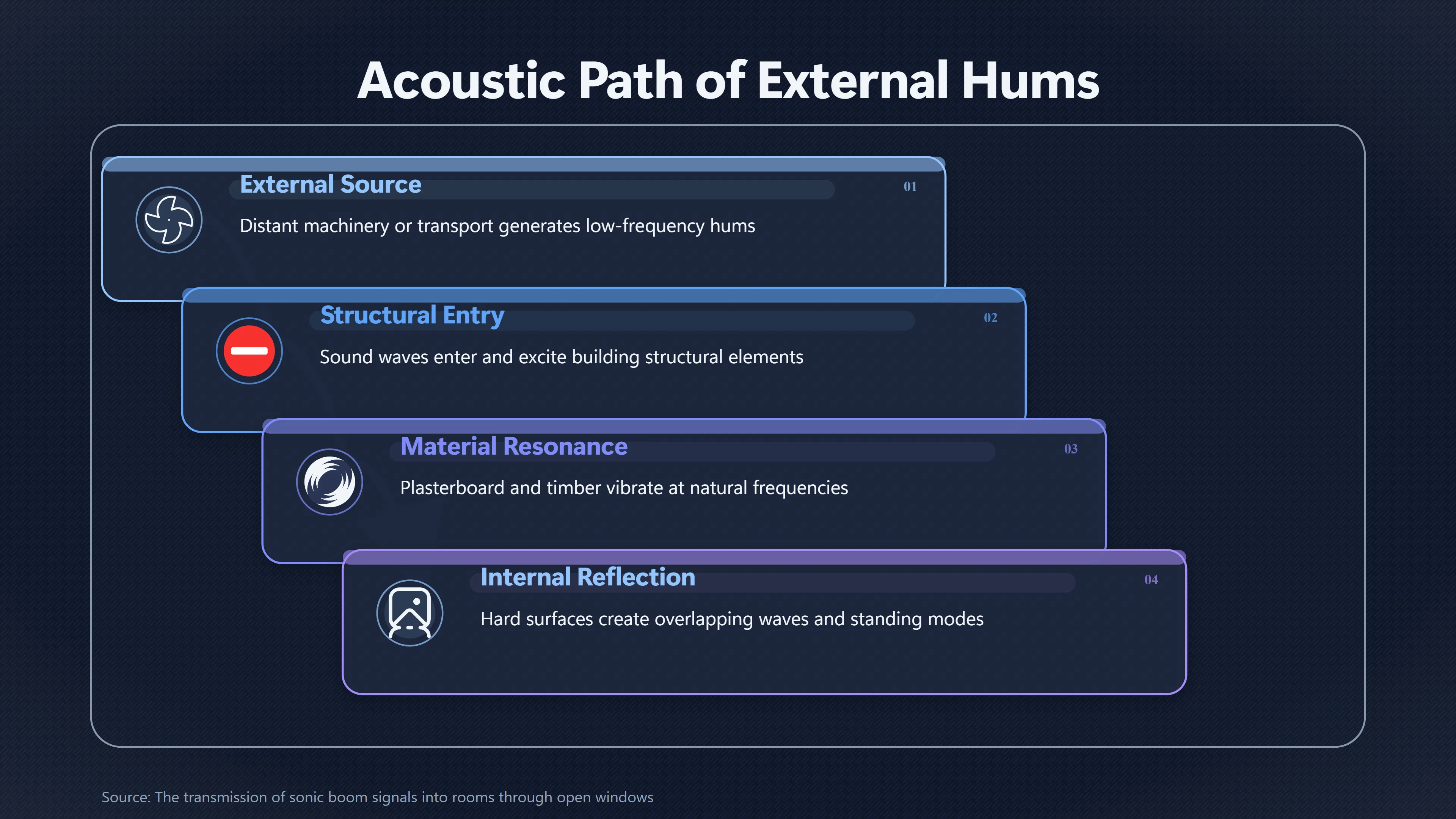
How building surfaces vibrate with low frequencies
Low-frequency sound has wavelengths measured in several metres, allowing it to interact with entire rooms rather than just individual objects. Instead of simply passing through an open window as a clearly identifiable sound, bass energy can excite structural elements of the building.
Large surfaces such as plasterboard walls, timber floors, concrete slabs and window panes all have natural vibration frequencies. When incoming sound contains energy near those frequencies, the structure may resonate and re-radiate the sound into the room. The listener therefore hears not only the original airborne sound but also vibrations emitted by the building itself.[ScienceDirect]sciencedirect.comInfrasonic sound pressure in dwellings at the Helmholtz resonance actuated by environmental noise and vibration - ScienceDirect…
This explains why someone may notice that:
- a window seems to “hum” even though the sound source is outside;
- a suspended ceiling appears to vibrate faintly;
- one wall sounds louder than another despite facing away from the source; or
- the hum is strongest when touching a floor or partition.
The effect is usually subtle rather than dramatic, but because the vibrating surface surrounds the listener, the brain may attribute the sound to the room instead of to a distant outdoor source.
Why reflections detach sound from its source
Indoors, the listener rarely hears only the direct sound arriving from outside. Every hard surface reflects part of the incoming wave.
With higher-pitched sounds these reflections are brief and directional cues remain relatively strong. Deep continuous hums behave differently. Their long wavelengths produce overlapping reflections that persist throughout the room, reducing the contrast between the direct sound and its echoes. Instead of pointing clearly towards the window or exterior wall, the sound field becomes diffuse.
Because the auditory system already struggles to determine the direction of narrow-band low-frequency sounds, the additional reflected energy can make localisation even less reliable. Rather than identifying an outdoor origin, listeners often report that the hum seems to fill the room or hover overhead.[Aalto University's research portal]research.aalto.fiAalto University's research portalThe Impact of Standing Waves on Localization Ability of Low-Frequency Sound Sources - Aalto University'…
The practical consequence is that moving only a short distance may completely change the perceived direction of the sound, even though the external source has not moved at all.

Why standing waves create indoor “hot spots”
One of the most important room effects is the standing wave, also called a room mode.
When low-frequency sound repeatedly reflects between parallel walls, floor and ceiling, certain frequencies reinforce themselves. This creates fixed regions where sound pressure is unusually high (antinodes) and others where it is greatly reduced (nodes).
Instead of experiencing a uniform hum throughout the house, a person may find that:
- one corner is noticeably louder than the centre of the room;
- the sound almost disappears a metre away;
- an upstairs bedroom hums while the room below does not; or
- a hallway seems quieter despite being closer to the outside wall.
Recent listening experiments show that these standing-wave patterns can significantly impair a person’s ability to judge where a very low-frequency sound is coming from. Interestingly, locations near pressure nodes—where the room cancels much of the direct sound—can be especially disruptive to localisation, because the reflected sound dominates what reaches the ears.[Aalto University's research portal]research.aalto.fiAalto University's research portalThe Impact of Standing Waves on Localization Ability of Low-Frequency Sound Sources - Aalto University'…
In other words, the room itself becomes part of the acoustic signal.
How to identify standing-wave hot spots in a room
A practical way to distinguish room resonance from a genuinely indoor source is to observe how the sound changes with position.
Signs that room modes are influencing what you hear include:
- Large changes over short distances. Walking half a metre can transform a loud hum into a barely audible one.
- Different rooms behaving differently. A bedroom may resonate strongly while the kitchen remains relatively quiet.
- Frequency-specific behaviour. Only one or two bass notes seem exaggerated instead of all low sounds.
- Little correlation with windows or doors. The loudest point is not necessarily nearest the outside.
Simple measurements with a calibrated microphone or acoustic analysis software often reveal narrow frequency peaks that match expected room modes. Professional acousticians use these measurements to separate structural resonance from the characteristics of the external sound source itself.[Tantrum Audio]tantrumaudio.co.ukTantrum Audio Understanding Room Modes in Studio Acoustics | Tantrum AudioTantrum Audio Understanding Room Modes in Studio Acoustics | Tantrum Audio
Why this matters when investigating mysterious hums
Reports of unexplained hums frequently describe sounds that seem to come from “inside the walls”, “the ceiling”, or “everywhere at once”. These descriptions are consistent with known acoustic behaviour and do not necessarily indicate that the sound originated within the building.
A distant industrial fan, electrical installation, transport corridor or other low-frequency source may enter through the building envelope, excite structural vibration, and then be reshaped by room resonances before reaching the listener. By the time the brain interprets the sound, many of the directional cues that normally reveal its origin have been altered or lost.[ScienceDirect]sciencedirect.comInfrasonic sound pressure in dwellings at the Helmholtz resonance actuated by environmental noise and vibration - ScienceDirect…
Within the broader discussion of why low-frequency sounds seem directionless, room resonance provides an important final piece of the puzzle. It shows that even when the source is entirely ordinary and located outdoors, the acoustics of an enclosed space can relocate the perceived origin, making an external hum feel as though it has emerged from the building itself.[Aalto University's research portal]research.aalto.fiAalto University's research portalThe Impact of Standing Waves on Localization Ability of Low-Frequency Sound Sources - Aalto University'…
Amazon book picks
Further Reading
Books and field guides related to Why An Outside Hum Can Seem Inside. Use these as the next step if you want deeper reading beyond the article.
Master Handbook of Acoustics
Practical Instruction on the Art and Science of Acoustic Design and Architecture Build your own acoustic environments such as recording s...
The Sound Book
A professor of acoustic engineering provides a tour of the world's most amazing sound phenomena, including creaking glaciers, whispering...
Architectural Acoustics
Architectural Acoustics, Second Edition presents a thorough technical overview of the discipline, from basic concepts to specific design...
Sound Reproduction
Covering designing listening experiences, acoustics and psychoacoustics this book shows how to design the best possible listening experie...
eBay marketplace picks
Marketplace Samples
Live-tested eBay searches with available results related to this page.
Selected fromUFO poster oneBay.co.uk.

Current eBay listing
VINTAGE UFO FLYING SAUCERS COMIC ADVERTISING A2 POSTER PRINT



Current eBay listing
I Want To Believe UFO Poster Giclée Fine Art Heavyweight Print
Endnotes
1.
Source: research.aalto.fi
Link:https://research.aalto.fi/en/publications/the-impact-of-standing-waves-on-localization-ability-of-low-frequ/
Source snippet
Aalto University's research portalThe Impact of Standing Waves on Localization Ability of Low-Frequency Sound Sources - Aalto University'...
2.
Source: sciencedirect.com
Link:https://www.sciencedirect.com/science/article/abs/pii/S0003682X03001178
Source snippet
Infrasonic sound pressure in dwellings at the Helmholtz resonance actuated by environmental noise and vibration - ScienceDirect...
3.
Source: research.aalto.fi
Link:https://research.aalto.fi/en/publications/impact-of-standing-waves-on-human-auditory-[perception
Source snippet
Aalto University's research portalImpact of standing waves on human auditory perception of low-frequency direction - Aalto University's r...
4.
Source: sciencedirect.com
Link:https://www.sciencedirect.com/science/article/pii/S0263224126004410
Source snippet
April 14, 2026 — Date: 14 April 2026 VIBRO-ACOUSTIC COUPLING CHARACTERISTIC OF RAILWAY-ADJACENT BUILDING: FROM OUT-OF-PLANE...
Published: April 14, 2026
5.
Source: sciencedirect.com
Link:https://www.sciencedirect.com/science/article/abs/pii/S0263224126004410
Source snippet
April 14, 2026 — MEASUREMENT Volume 269, 14 April 2026, 120732 VIBRO-ACOUSTIC COUPLING CHARACTERISTIC OF RAILWAY-ADJACENT BU...
Published: April 14, 2026
6.
Source: aaltodoc.aalto.fi
Link:https://aaltodoc.aalto.fi/items/7474018c-65a1-402a-85f6-e7736fdf4a88
7.
Source: sciencedirect.com
Title: The transmission of sonic boom signals into rooms through open windows
Link:https://www.sciencedirect.com/science/article/pii/0022460X72904774
8.
Source: aaltodoc.aalto.fi
Link:https://aaltodoc.aalto.fi/items/538244f2-f339-4348-9a6f-d8f94d03f387
9.
Source: research.aalto.fi
Link:https://research.aalto.fi/fi/publications/the-impact-of-standing-waves-on-localization-ability-of-low-frequ/
10.
Source: tantrumaudio.co.uk
Title: Tantrum Audio Understanding Room Modes in Studio Acoustics | Tantrum Audio
Link:https://tantrumaudio.co.uk/learn/understanding-room-modes
Additional References
11.
Source: soundtechnology.com.au
Link:https://soundtechnology.com.au/articles/room-modes-explained-bass-problems-fixes
Source snippet
July 14, 2026 — ROOM MODES EXPLAINED: WHY YOUR BASS SOUNDS WRONG AND HOW TO FIX IT By Jonno Fraser · July 14, 2026 · 10 min read Image: D...
Published: July 14, 2026
12.
Source: wavetrain.com.au
Title: Bass Management: Home Theatre Guide | Wavetrain Cinemas
Link:https://www.wavetrain.com.au/home-cinema-bass-management/
Source snippet
July 8, 2026 — ROOM MODES AND THE PROBLEM OF STANDING WAVES When a low frequency sound wave is generated in an enclosed space, it travels...
Published: July 8, 2026
13.
Source: youtube.com
Title: Standing Waves and Harmonics
Link:https://www.youtube.com/watch?v=0Rfushlee0U
Source snippet
Room modes standing waves low frequency room acoustics resonance How BASS Works (In Rooms) - Acoustic Geometry Acoustic Geometry...
14.
Source: wavetrain.com.au
Title: Acoustic Design for Your Home Cinema | Wavetrain Cinemas
Link:https://www.wavetrain.com.au/home-cinema-acoustic-design/
Source snippet
When those pressure waves meet a boundary such as a wall, floor or ceiling, they reflect. In...
15.
Source: labacoustics.us
Link:https://www.labacoustics.us/insights/room-modes
16.
Source: researchgate.net
Link:https://www.researchgate.net/publication/384996333_The_Impact_of_Standing_Waves_on_Localization_Ability_of_Low-Frequency_Sound_Sources
17.
Source: research.polyu.edu.hk
Link:https://research.polyu.edu.hk/en/publications/low-frequency-coupled-interior-sound-fields-due-to-vibrating-sour/
18.
Source: itu.int
Title: itu t hstp sld venue 2024 04 guidelines for safe listening at venues and events
Link:https://www.itu.int/epublications/en/publication/itu-t-hstp-sld-venue-2024-04-guidelines-for-safe-listening-at-venues-and-events
19.
Source: researchgate.net
Title: (PDF) Sound Insulation of Building Elements at Low Frequency: A Modal Approach
Link:https://www.researchgate.net/publication/279536519_Sound_Insulation_of_Building_Elements_at_Low_Frequency_A_Modal_Approach
20.
Source: acousplan.com
Title: Acous Plan™ — Room Modes & Standing Waves: The Complete Low-Frequency Guide
Link:https://acousplan.com/blog/room-modes-standing-waves-bass-guide