Within The Hum
What Did Scientists Measure During the Windsor Hum?
Windsor researchers recorded real low-frequency activity and repeatedly localized its likely origin toward the industrial area around Zug Island.
On this page
- How residents described the vibration
- What monitoring revealed about frequency and direction
- Why Zug Island remained the leading source
Page outline Jump by section
Introduction
The Windsor Hum stands apart from many other reported “Hum” cases because researchers did not simply collect witness accounts—they recorded measurable low-frequency acoustic activity and carried out multiple scientific attempts to determine where it came from. Beginning in 2011, residents in Windsor, Ontario, described a deep rumble or vibration that was often felt as much as heard. Subsequent investigations by Natural Resources Canada, the University of Windsor and Western University confirmed that an external physical signal was present during at least some reported events. While the studies stopped short of identifying one specific machine, they produced the strongest instrumental evidence of any major Hum case and repeatedly narrowed the likely origin to heavy industrial activity across the Detroit River, particularly around Zug Island.[Global Affairs Canada]international.gc.caSummary of the ‘Windsor Hum Study’ Results…
How residents described the vibration
Witness reports showed remarkable consistency before extensive measurements even began. People commonly compared the sensation to:
- A distant idling diesel engine.
- A blast furnace or industrial machinery.
- A low, pulsating rumble.
- A vibration that could be felt through buildings rather than simply heard.
Complaints began in early 2011 and were concentrated in southern Windsor and nearby LaSalle. Many reports described episodes lasting from minutes to several hours, with the sound appearing intermittently rather than continuously. The fact that residents independently described similar low-frequency characteristics gave researchers a useful starting point for designing monitoring equipment capable of detecting frequencies below those typical of ordinary environmental noise.[Global Affairs Canada]international.gc.caSummary of the ‘Windsor Hum Study’ Results…
What monitoring revealed about frequency and direction
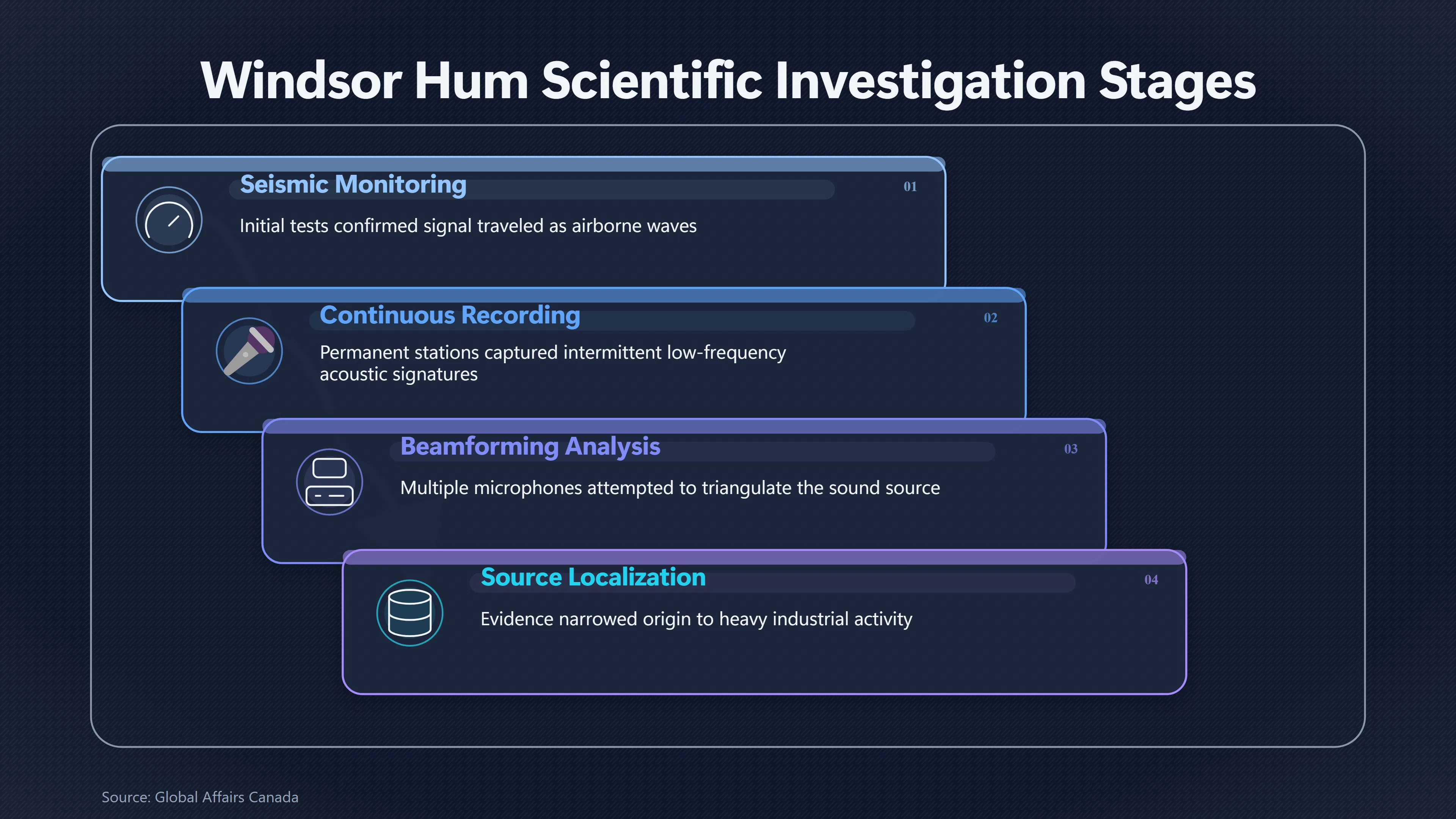
The investigations progressed through several increasingly sophisticated stages, each answering a different question about the Hum.
Natural Resources Canada established that it was airborne
One of the earliest government studies used seismic monitoring between June and August 2011. An important result was that the suspected signal behaved like an acoustic wave travelling through the air rather than a seismic vibration propagating through the ground. The measurements also identified a dominant tone near 35 Hz, a very low frequency consistent with many residents’ descriptions. Triangulation suggested that the source lay in the general direction of Zug Island.[Global Affairs Canada]international.gc.caSummary of the ‘Windsor Hum Study’ Results…
Long-term monitoring captured the Hum directly
The University of Windsor then deployed permanent and portable environmental noise monitoring stations throughout Windsor-Essex. Because the Hum occurred unpredictably, continuous unattended monitoring was essential.
Researchers succeeded in recording several genuine Hum events, allowing them to identify an acoustic signature instead of relying solely on subjective reports. They found that:
- the signal was intermittent rather than constant;
- its strongest energy lay in the low-frequency range;
- recorded events matched the timing and character of many public complaints;
- the phenomenon appeared only on a limited number of monitoring days, making source identification much more difficult.
This represented a major advance over earlier Hum investigations elsewhere, where researchers often failed to capture any clear external signal.[Global Affairs Canada]international.gc.caSummary of the ‘Windsor Hum Study’ Results…

Beamforming attempted to pinpoint the source
After characterising the signal, the researchers employed acoustic beamforming—a technique that combines measurements from multiple microphones to estimate the direction from which sound arrives.
The project was hampered by an unfortunate coincidence: during the periods when the beamforming equipment was deployed on the river, the Hum largely failed to occur. As a result, the team could not produce the definitive directional image needed to identify one specific industrial installation.
Even so, the overall acoustic evidence remained consistent with an origin from the heavily industrial area around Zug Island rather than from residential neighbourhoods in Windsor itself.[Global Affairs Canada]international.gc.caSummary of the ‘Windsor Hum Study’ Results…
Why Zug Island remained the leading source
The evidence pointing towards Zug Island did not depend on a single experiment. Instead, several independent observations converged.
Natural Resources Canada’s initial measurements placed the apparent source in that direction. Later acoustic monitoring by the University of Windsor concluded that the measured characteristics were most consistent with industrial operations on Zug Island, particularly blast furnace activity. Researchers emphasised that they had not identified a single “smoking gun” machine, but regarded the industrial complex as the most likely origin based on the available evidence.[gc.ca]international.gc.caGlobal Affairs CanadaSummary of the ‘Windsor Hum Study’ Results…
An important limitation was access. Canadian researchers could not freely instrument suspected facilities on the American side of the river. Without microphones and vibration sensors placed directly on the industrial equipment, they could not isolate one individual source with engineering certainty. Consequently, the final reports described the conclusion as a well-supported localisation rather than definitive proof of one machine.[Global Affairs Canada]international.gc.caSummary of the ‘Windsor Hum Study’ Results…
Why not every study reached exactly the same conclusion
The Windsor Hum illustrates how difficult low-frequency acoustics can be to investigate in a complex industrial landscape.
A separate infrasound array study by Western University detected low-frequency signals but found that some measured arrival directions did not consistently point towards Zug Island. Researchers noted that local sound propagation could be distorted by atmospheric conditions, terrain, reflections from the river, ground effects and surrounding industrial structures. They therefore concluded that, although they detected relevant low-frequency signals, they could not conclusively geolocate the source during their relatively short deployment.[ResearchGate]researchgate.netOpen source on researchgate.net.
Rather than contradicting the broader investigation, this highlighted the practical difficulty of tracing intermittent low-frequency sound outdoors. The Hum was not continuously active, and environmental conditions could alter the apparent direction from which the sound arrived.
What the measurements mean for UFO speculation
Within discussions of unexplained sounds and alleged UFO noises, the Windsor measurements are significant because they demonstrate that at least one famous Hum involved a measurable external acoustic phenomenon rather than solely individual perception.
However, the studies do not support an extraordinary explanation. Instead, they indicate:
- a real low-frequency airborne sound existed during documented Hum events;
- the signal was repeatedly associated with the direction of an industrial zone;
- no evidence connected the phenomenon with unidentified aerial phenomena or extraterrestrial activity;
- the remaining uncertainty concerns which specific industrial process produced the sound, not whether the sound itself existed.[gc.ca]international.gc.caGlobal Affairs CanadaSummary of the ‘Windsor Hum Study’ Results…
The Windsor case therefore represents one of the strongest examples of scientists successfully measuring an otherwise mysterious Hum. Although the exact machine responsible was never conclusively identified, the investigations substantially narrowed the explanation from an unexplained mystery to a probable industrial source supported by multiple independent measurements.[Global Affairs Canada]international.gc.caSummary of the ‘Windsor Hum Study’ Results…

Amazon book picks
Further Reading
Books and field guides related to What Did Scientists Measure During the Windsor Hum?. Use these as the next step if you want deeper reading beyond the article.
Master Handbook of Acoustics
The most complete and current guide to architectural acoustics principles and practices Design and construct audiophile-quality sonic env...
Engineering Noise Control: Theory and Practice
The practice of engineering noise control demands a solid understanding of the fundamentals of acoustics, the practical application of cu...
Acoustics: Sound Fields and Transducers
Long-awaited update and expansion of a widely recognised classic in the field by pioneering acoustics expert, Leo L. Beranek Builds upon...
eBay marketplace picks
Marketplace Samples
Live-tested eBay searches with available results related to this page.
Selected fromindustrial poster oneBay.co.uk.




Endnotes
1.
Source: researchgate.net
Link:https://www.researchgate.net/publication/325849648_Deployment_of_a_short-term_geophysical_field_survey_to_monitor_acoustic_signals_associated_with_the_Windsor_Hum
2.
Source: infonews.ca
Link:https://infonews.ca/news/511532/study-confirms-windsor-hum-comes-from-u-s-island-but-mystery-remains/
Source snippet
Study confirms Windsor hum comes from U.S. island but mystery remains | iNFOnews.ca...
3.
Source: researchgate.net
Link:https://www.researchgate.net/publication/368531535_Continuous_Measurements_and_Source_Apportionment_of_Ambient_PM25-Bound_Elements_in_Windsor_Canada
Source snippet
February 14, 2023 — parameters (i.e., temperature, wind direction, and wind speed) were monitored hourly across three seasons (i.e., spri...
Published: February 14, 2023
4.
Source: researchgate.net
Link:https://www.researchgate.net/figure/A-regional-map-of-the-Windsor-LaSalle-Detroit-area-showing-the-general-region-where_fig1_325849648
5.
Source: international.gc.ca
Title: Global Affairs Canada
Link:https://www.international.gc.ca/department-ministere/windsor_hum_results-bourdonnement_windsor_resultats.aspx?lang=eng&pedisable=true
Source snippet
Summary of the ‘Windsor Hum Study’ Results...
Additional References
6.
Source: eppcgs.org
Link:https://www.eppcgs.org/article/doi/10.26464/epp2018032
Source snippet
Silber. 2018: Deployment of a short-term geophysical field survey to monitor acoustic signals associated with the Windsor Hum. Ear...
7.
Source: agupubs.onlinelibrary.wiley.com
Title: Silber, Corresponding Author Elizabeth A. Silber * elizabeth_silber@br
Link:https://agupubs.onlinelibrary.wiley.com/doi/abs/10.26464/epp2018032
Source snippet
of a short‐term geophysical field survey to monitor acoustic signals associated with the Windsor Hum - Silber - 2018 - Earth and Planetar...
8.
Source: youtube.com
Title: The Hum Pt II: The Strange Sound Heard All Over the World
Link:https://www.youtube.com/watch?v=Ev5MFCg0O1I
Source snippet
This news coverage details the acoustic monitoring efforts across the US-Canada border and the specific frequency data collected near Zug...
9.
Source: youtube.com
Link:https://www.youtube.com/watch?v=VB1707GeXq8
Source snippet
The Windsor Hum: Audio recording...
10.
Source: youtube.com
Title: The Controversial Sound Only 2% Of People Hear
Link:https://www.youtube.com/watch?v=zy_ctHNLan8
Source snippet
The Hum Pt II: The Strange Sound Heard All Over the World...
11.
Source: globalnews.ca
Link:https://globalnews.ca/news/236269/annoying-hum-plaguing-windsor-ont-residents-piques-foreign-affairs-curiosity/
12.
Source: globalnews.ca
Link:https://globalnews.ca/news/236293/annoying-hum-plaguing-windsor-ont-residents-piques-foreign-affairs-curiosity-2/
13.
Source: eppcgs.org
Link:https://www.eppcgs.org/cn/article/doi/10.26464/epp2018032?viewType=HTML
14.
Source: eppcgs.org
Link:https://www.eppcgs.org/article/doi/10.26464/epp2018032?viewType=HTML
15.
Source: bksv.com
Link:https://www.bksv.com/zh/knowledge/blog/sound/windsor-hum