Within Identify Sources
Can Neighboring Reports Trace a Sound's Path?
Reports from several locations can show whether a sound moved like an aircraft or remained fixed like distant machinery.
On this page
- Building a reliable witness timeline
- Patterns that indicate a moving aircraft
- Patterns that suggest a fixed source
Page outline Jump by section
Introduction
When several people in different neighbourhoods report the same unusual overhead sound, the timing of those reports can become one of the strongest tests of whether the source was actually moving. Instead of treating each witness account in isolation, comparing when the sound was first heard, when it was loudest and when it faded can reveal a consistent travel path that matches an aircraft or another mobile source. If the reports do not show a coherent progression, they may instead point towards a fixed industrial source whose sound was carried unusually far by atmospheric conditions. Used carefully, cross-neighbourhood timing transforms scattered anecdotes into evidence that can be checked against known flight paths, weather conditions and geography rather than relying on impressions alone.[faa.gov]faa.govCommunity Response to Noise | Federal Aviation AdministrationJuly 22, 2022…
Can neighbouring reports trace a sound’s path?
A single witness can easily misjudge where a low-frequency sound originated. Human hearing is poor at locating deep, sustained tones, especially at night or under cloudy skies. However, a series of independent reports from different locations provides information that no individual observer possesses.
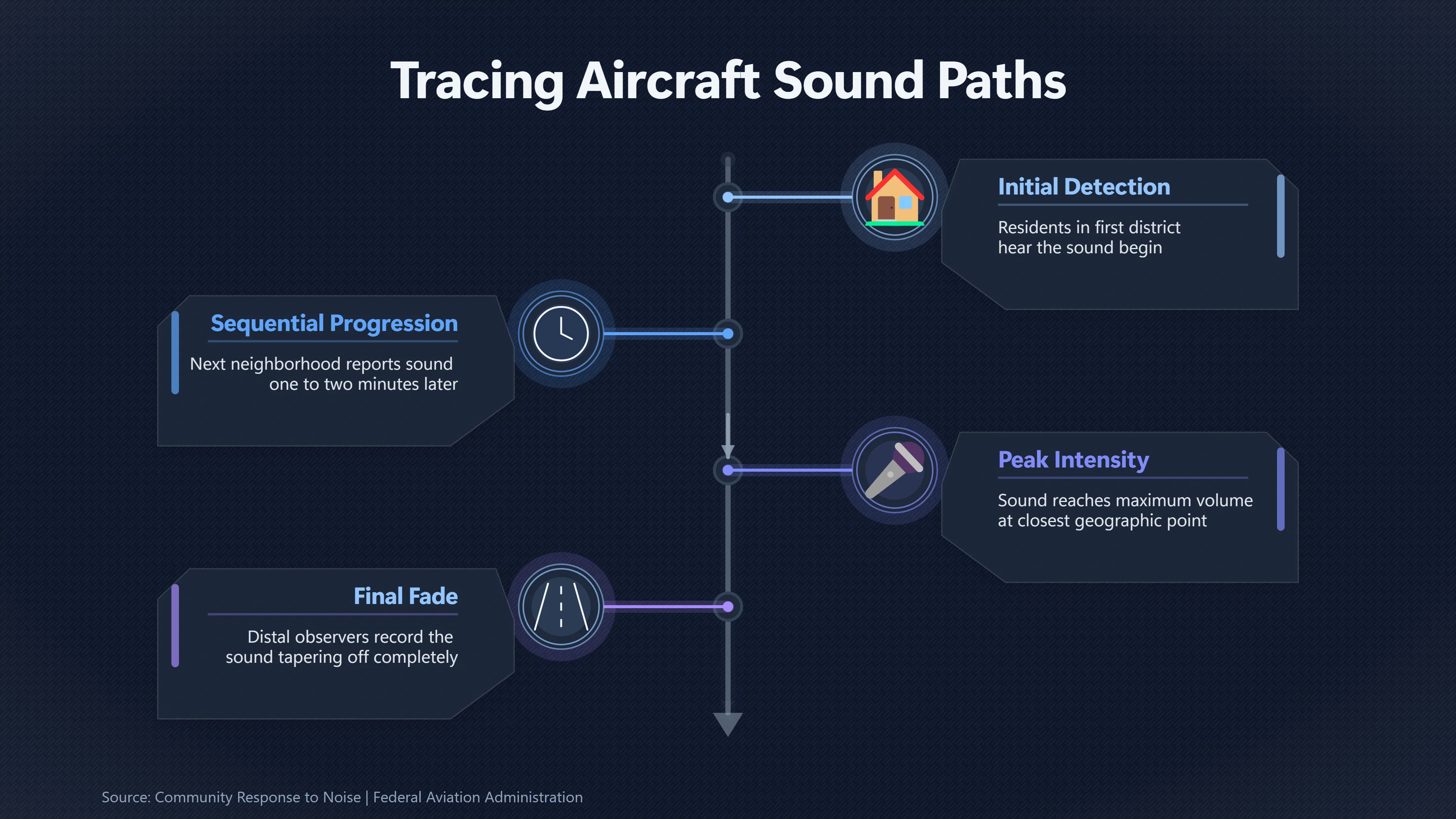
If a sound source is moving, the reports should usually show a logical sequence. For example, residents in one district hear the sound first, people in the next neighbourhood report it a minute or two later, and those farther along the same line hear it last. Even allowing for differences in reaction time and the delay caused by the finite speed of sound, the overall pattern often follows the movement of an aircraft.
By contrast, if people across a wide area report hearing the sound begin and end at nearly the same time, the explanation may be different. A stationary industrial source, large ventilation system or distant motorway can become audible over many kilometres when atmospheric conditions refract sound back towards the ground. Under those conditions, people in several neighbourhoods may all notice the same distant source without it having travelled between them.[faa.gov]faa.govCommunity Response to Noise | Federal Aviation AdministrationJuly 22, 2022…
Building a reliable witness timeline
The value of multiple reports depends more on consistency than on the number of witnesses. A handful of accurately timed observations is often more useful than dozens of vague recollections.
Useful information includes:
- The exact or approximate time the sound was first noticed.
- When it became loudest.
- When it faded or stopped.
- The observer’s location.
- Whether the sound appeared to move or remained in one direction.
- Whether any visual observations accompanied the sound.
Independent accounts are especially valuable because they reduce the risk that later discussion influences people’s memories. Reports collected from social media, neighbourhood groups or emergency call logs can sometimes be arranged chronologically to reveal a clear progression across an urban area.
Maps become particularly informative when each report is plotted with its timestamp. Even without sophisticated acoustic modelling, a moving pattern often becomes visually obvious once locations are arranged in time order.
Patterns that indicate a moving aircraft
A moving aircraft generally produces several recognisable timing characteristics.
A consistent geographic progression. Reports advance steadily across neighbouring districts in the same direction rather than appearing randomly.
Reasonable travel times. The intervals between reports broadly match the speed of an aircraft after allowing for sound propagation delays. Witnesses rarely experience perfectly sequential timing because sound from a high-altitude aircraft may reach different observers after the aircraft has already moved well beyond its closest point.
Changing sound character. Observers ahead of the aircraft’s path may describe an approaching rumble, while those behind it report a receding roar. Different neighbourhoods often describe different phases of the same event.
Agreement with known operations. When the inferred movement aligns with recorded commercial flights, known helicopter routes or military training areas, the timing evidence becomes substantially stronger. Aircraft noise depends not only on the flight path but also on aircraft type, engine power, altitude and local weather, meaning neighbouring communities can experience noticeably different sound levels from the same flight.[faa.gov]faa.govCommunity Response to Noise | Federal Aviation AdministrationJuly 22, 2022…

Patterns that suggest a fixed source
Some timing patterns point away from an overhead moving object.
A nearly simultaneous onset across multiple neighbourhoods is difficult to reconcile with a single aircraft passing overhead unless the witnesses are very close together. Instead, it may indicate that changing atmospheric conditions suddenly made a distant fixed source audible over a much larger area.
Other indicators include:
- Reports remaining strongest from the same compass direction regardless of observer location.
- Similar descriptions continuing for long periods without a clear progression.
- Multiple evenings showing the same timing under comparable weather conditions.
- Correlation with industrial operating schedules rather than aircraft movements.
Temperature inversions deserve particular attention. During an inversion, warmer air overlies cooler surface air, bending sound waves back towards the ground. This can allow distant machinery, transport corridors or airport operations to be heard across neighbourhoods that would normally be outside the audible range, creating the impression of an unexplained overhead source.[NOAA]prod-01-alb-www-noaa.woc.noaa.govThe Sound of Thunder | National Oceanic and Atmospheric AdministrationThe Sound of Thunder | National Oceanic and Atmospheric Administration…
Interpreting disagreements between witnesses
Conflicting reports do not necessarily invalidate the evidence. Several factors naturally produce variation:
- People’s clocks may differ by a minute or more.
- Many witnesses estimate times after the event rather than recording them immediately.
- Buildings, hills and vegetation alter local sound levels.
- Low-frequency sounds are difficult for humans to localise accurately.
- Wind and atmospheric layering can cause one neighbourhood to hear the sound much more clearly than another.
Rather than expecting perfect agreement, investigators should look for the overall trend. If independent reports consistently form a directional sequence, that pattern is often more informative than minor disagreements over exact times.
Why timing evidence matters
Cross-neighbourhood timing is one of the simplest ways to distinguish between an apparently mysterious overhead sound and an ordinary moving source. It does not identify the source by itself, but it provides a testable hypothesis that can then be compared with aircraft tracking data, weather records and local activity.
Within the broader task of identifying ordinary explanations for reported UFO noises, this approach shifts the discussion from isolated impressions to measurable patterns. A sound that appears to “travel” through successive neighbourhoods is far more consistent with a moving aircraft or similar vehicle than with a stationary mystery, while reports that remain synchronised across a wide area may instead reflect unusual sound propagation from a fixed source rather than anything overhead.[faa.gov]faa.govCommunity Response to Noise | Federal Aviation AdministrationJuly 22, 2022…
Amazon book picks
Further Reading
Books and field guides related to Can Neighboring Reports Trace a Sound's Path?. Use these as the next step if you want deeper reading beyond the article.
The Sound Book: The Science of the Sonic Wonders of the World
A professor of acoustic engineering provides a tour of the world's most amazing sound phenomena, including creaking glaciers, whispering...
Master Handbook of Acoustics
Practical Instruction on the Art and Science of Acoustic Design and Architecture Build your own acoustic environments such as recording s...
Environmental Noise Pollution: Noise Mapping, Public Health,...
Environmental Noise Pollution, Second Edition, addresses the key debates surrounding environmental noise pollution, its modelling and mit...
The Science of Sound
Written for students without a background in mathematics or physics, this textbook provides an introduction to the study of acoustics. It...
eBay marketplace picks
Marketplace Samples
Live-tested eBay searches with available results related to this page.
Selected fromaircraft model oneBay.co.uk.

Endnotes
1.
Source: faa.gov
Title: Community Response to Noise | Federal Aviation Administration
Link:https://www.faa.gov/noise/aviation_noise/community_response
Source snippet
July 22, 2022...
Published: July 22, 2022
2.
Source: faa.gov
Title: Noise | Federal Aviation Administration
Link:https://www.faa.gov/noise
Source snippet
While there are many benefits to air travel, aviation noise can be a concern for communities. The FAA is limited b...
3.
Source: prod-01-alb-www-noaa.woc.noaa.gov
Title: The Sound of Thunder | National Oceanic and Atmospheric Administration
Link:https://prod-01-alb-www-noaa.woc.noaa.gov/jetstream/lightning/sound-of-thunder
Source snippet
The Sound of Thunder | National Oceanic and Atmospheric Administration...
4.
Source: GOV.UK
Link:https://www.gov.uk/government/publications/aviation-night-noise-effects-anne-study
Source snippet
Night Noise Effects (ANNE) study - GOV.UKJune 10, 2026 — AVIATION NIGHT NOISE EFFECTS (ANNE) STUDY Examining the relationship between exp...
Published: June 10, 2026
5.
Source: faa.gov
Link:https://www.faa.gov/air_traffic/community_engagement/frequently-asked-questions
Source snippet
January 23, 2026 — COMMUNITY ENGAGEMENT FREQUENTLY ASKED QUESTIONS * Community Engagement * National Airspace System Roles and Responsibi...
Published: January 23, 2026
6.
Source: ready.noaa.gov
Link:https://www.ready.noaa.gov/READYthetahelp.php
Source snippet
Tools - Potential temperature versus height chartsMay 12, 2025 — STABILITY PLOT ABBREVIATIONS Image: READY logo HOW TO INTERPRET POTENTIA...
Published: May 12, 2025
7.
Source: oceanservice.noaa.gov
Link:https://oceanservice.noaa.gov/facts/sound.html?platform=hootsuite
8.
Source: oceanservice.noaa.gov
Link:https://oceanservice.noaa.gov/facts/sonar.html
9.
Source: faa.gov
Title: Fundamentals of Noise and Sound | Federal Aviation Administration
Link:https://www.faa.gov/noise/aviation_noise/fundamentals_of_noise
10.
Source: faa.gov
Title: Fundamentals of Noise and Sound | Federal Aviation Administration
Link:https://www.faa.gov/regulations_policies/policy_guidance/noise/basics
11.
Source: faa.gov
Title: Aviation Noise | Federal Aviation Administration
Link:https://www.faa.gov/regulations_policies/policy_guidance/noise
12.
Source: airporttech.tc.faa.gov
Title: tc 21 4 analysis of nes
Link:https://www.airporttech.tc.faa.gov/Products/Airport-Safety-Papers-Publications/Airport-Safety-Detail/tc-21-4-analysis-of-nes
13.
Source: psl.noaa.gov
Link:https://psl.noaa.gov/seminars/Abstracts/ostashev2007.html
14.
Source: fisheries.noaa.gov
Title: understanding sound ocean
Link:https://www.fisheries.noaa.gov/insight/understanding-sound-ocean
15.
Source: ndbc.noaa.gov
Title: temps ans.shtml
Link:https://www.ndbc.noaa.gov/education/temps_ans.shtml
16.
Source: forecast.weather.gov
Link:https://forecast.weather.gov/glossary.php?word=INVERSION
17.
Source: weather.gov
Title: NW S Jet Stream
Link:https://www.weather.gov/source/zhu/ZHU_Training_Page/lightning_stuff/lightning2/thunder.html
18.
Source: forecast.weather.gov
Link:https://forecast.weather.gov/glossary.php?word=r
Additional References
19.
Source: thefederalregister.org
Title: This collection involves information voluntar
Link:https://thefederalregister.org/documents/2026-09236/agency-information-collection-activities-request-for-comments-clearance-of-renewed-approval-of-information-collection-fa
Source snippet
Agency Information Collection Activities: Request for Comments; Clearance of Renewed Approval of Information Collection: FAA Aircraft Noi...
20.
Source: gao.gov
Link:https://www.gao.gov/products/gao-21-103933
21.
Source: congress.gov
Link:https://www.congress.gov/crs-product/IF11420
22.
Source: youtube.com
Title: The Doppler Effect: Visualizing Sound Waves and Frequency Changes
Link:https://www.youtube.com/watch?v=nWlw9v9vbfA
Source snippet
5 How to Detect Drone Sounds using AI & R...
23.
Source: youtube.com
Title: Locating Sound Sources: Time Difference of Arrival
Link:https://www.youtube.com/watch?v=SfKCwQcsQA0
Source snippet
3 How to calculate Time Difference of Arrival (TDOA) in Sound...
24.
Source: sciencedirect.com
Link:https://www.sciencedirect.com/science/article/abs/pii/S0022460X78800339
25.
Source: sciencedirect.com
Link:https://www.sciencedirect.com/science/article/pii/S0022460X78800339
26.
Source: centaur.reading.ac.uk
Link:https://centaur.reading.ac.uk/81843/
27.
Source: researchgate.net
Link:https://www.researchgate.net/publication/22549986_Minimum_auditory_movement_angle_Binaural_localization_of_moving_sound_sources
28.
Source: sciencedirect.com
Title: Moving sound source localization based on triangulation method
Link:https://www.sciencedirect.com/science/article/pii/S0022460X16304473