Within Perception
How Retelling Can Rewrite a UFO Sound Memory
Repeated discussion and later information can turn a vague remembered noise into a detailed and confident account.
On this page
- Why memory is reconstructed during recall
- How conversations and leading questions add detail
- Why vivid memories may still be inaccurate
Page outline Jump by section
Introduction
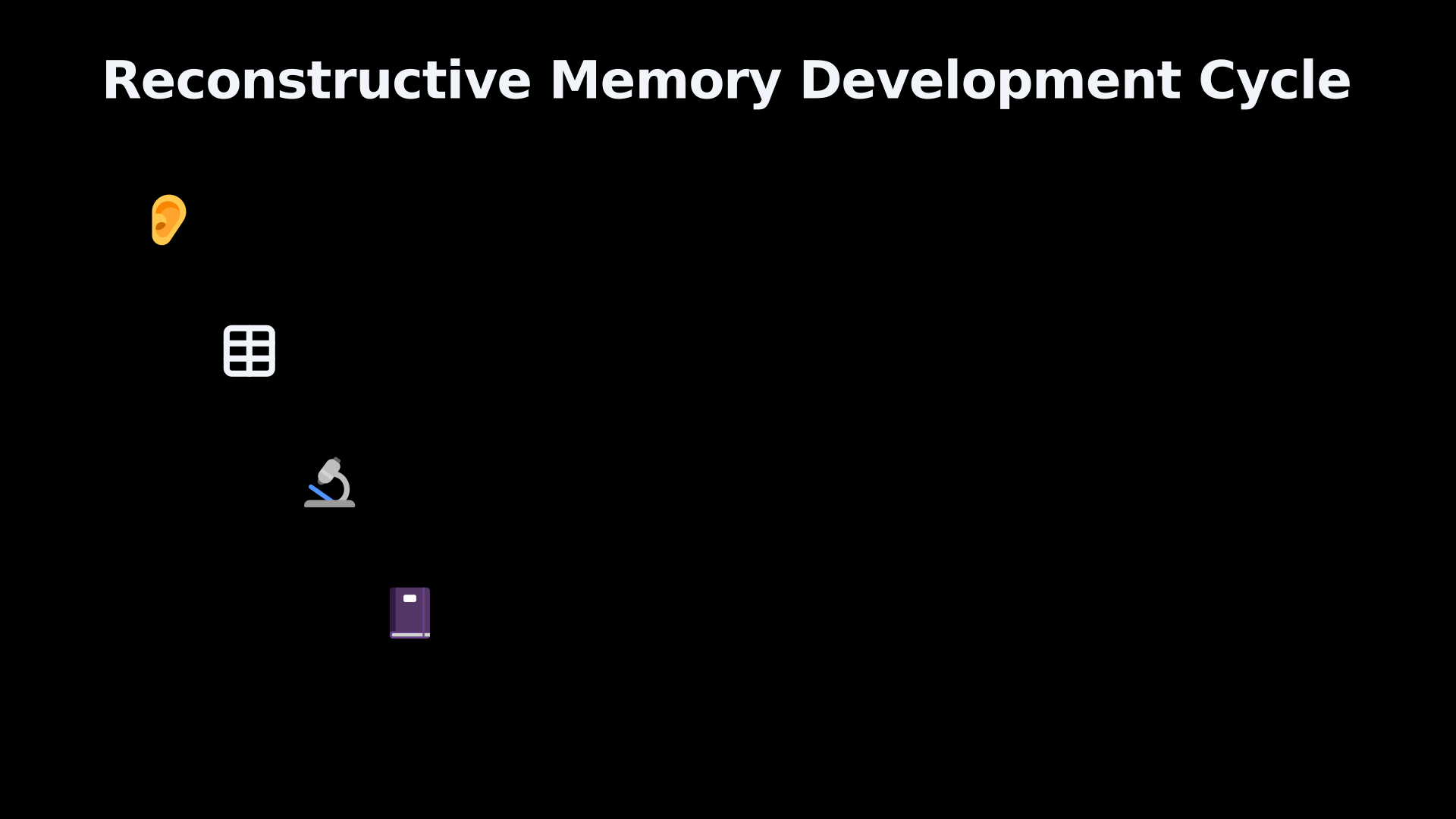
When people later describe the sound they associate with a UFO sighting, the account may be more detailed and more confidently told than it was immediately after the event. That increased coherence does not necessarily mean the memory has become more accurate. Decades of psychological research show that human memory is reconstructive rather than a literal recording. Each act of remembering is also an opportunity for the memory to be updated, reshaped or supplemented by later information. In the context of UFO reports, this means an initially uncertain recollection—such as “I heard an odd noise”—can gradually become a vivid description of a humming, buzzing or pulsing sound that feels entirely authentic to the witness.[cambridge.org]cambridge.orgCambridge University PressRE-EVALUATING THE CREDIBILITY OF EYEWITNESS TESTIMONY: THE MISINFORMATION EFFECT AND THE OVERCRITICAL JUROR | E…
Understanding this process does not imply that witnesses are dishonest or imagining events. Instead, it highlights a well-established feature of eyewitness memory that is especially relevant when unusual experiences are discussed repeatedly, compared with other accounts or explored through suggestive questioning.
Why memory is reconstructed during recall
Remembering is an active process. Rather than retrieving a perfect recording, the brain rebuilds an event using fragments of stored information together with current knowledge, expectations and beliefs. Every recall episode can therefore slightly alter what is remembered the next time.
Psychologists have shown that recalling an event does not simply strengthen the original memory. Once a memory is reactivated, it can become vulnerable to incorporating new information before it is stored again. Experimental work suggests that even an early interview can increase susceptibility to later misleading information under some circumstances, illustrating that repeated retrieval and later exposure interact in complex ways.[Association for Psychological Science]psychologicalscience.orgAssociation for Psychological ScienceRecalling a Witnessed Event Increases Eyewitness Suggestibility - Psychological Science - APS…
For reported UFO sounds, this mechanism is particularly important because auditory memories are often less precise than visual memories. A witness may genuinely remember hearing something unusual while remaining uncertain about its exact qualities. Later attempts to explain or describe the sound naturally encourage the brain to fill gaps with details that make the overall experience more coherent.
Instead of remaining as an uncertain impression, the remembered sound may gradually acquire:
- A clearer pitch or rhythm.
- A specific label such as “electrical hum”, “metallic buzz” or “low-frequency vibration”.
- A stronger perceived connection to the observed object.
- A more definite sequence of events.
These additions may reflect reconstruction rather than deliberate invention.
How conversations and leading questions add detail
Much of the reshaping of memory happens socially. After an unusual event, people often compare experiences with family members, friends, investigators or other witnesses. Each conversation introduces new descriptions, interpretations and assumptions that can become woven into later recollections.
For example, a witness who originally says, “There was some kind of noise,” may later hear others describe a humming sound. During subsequent retellings, that description can become incorporated into the witness’s own account without conscious awareness of its external origin. Psychologists describe this as a source-monitoring problem: people may remember information accurately while forgetting where it came from.[Cambridge University Press]cambridge.orgCambridge University PressRE-EVALUATING THE CREDIBILITY OF EYEWITNESS TESTIMONY: THE MISINFORMATION EFFECT AND THE OVERCRITICAL JUROR | E…
Leading questions can have a similar effect. Questions such as:
- “Did the object make a buzzing sound?”
- “How loud was the humming?”
- “Could you feel the vibration?”
implicitly suggest that such characteristics existed. Even when asked innocently, these prompts encourage witnesses to search for matching details in memory instead of simply reporting uncertainty.
Research on eyewitness testimony consistently finds that post-event information can alter later recollections without witnesses recognising that their memories have changed.[cambridge.org]cambridge.orgCambridge University PressRE-EVALUATING THE CREDIBILITY OF EYEWITNESS TESTIMONY: THE MISINFORMATION EFFECT AND THE OVERCRITICAL JUROR | E…

Why repeated retelling increases confidence
One of the more counter-intuitive findings in memory research is that confidence and accuracy do not always increase together.
Repeatedly telling the same story makes it easier to retrieve. Because the account becomes more fluent and familiar, it often feels increasingly true to the person remembering it. Experimental studies have shown that repetition alone—not necessarily confirmation from multiple independent people—can increase both belief in misleading information and confidence that it is accurate.[PubMed]pubmed.ncbi.nlm.nih.govOpen source on nih.gov.
Applied to UFO sound reports, this means a witness who recounts the experience many times may sincerely become more certain that:
- the sound had a particular tone;
- it came directly from the observed object;
- the sequence of events is remembered precisely; or
- specific acoustic features were noticed at the time.
Greater confidence therefore cannot be treated as independent evidence that the remembered sound has become more faithful to the original experience.
Why vivid memories may still be inaccurate
People often assume that especially vivid memories must be especially reliable. Psychological evidence does not support such a simple relationship.
An unusual or emotionally significant event can certainly produce a powerful memory, but vividness reflects the subjective experience of remembering rather than objective accuracy. A detailed recollection may contain genuine sensory impressions mixed with later inferences, conversations, expectations or culturally familiar descriptions.
This distinction matters in UFO investigations because witnesses frequently report striking experiences that they have reflected on for years. During that time, memories may become internally consistent while drifting away from the original sensory experience.
A witness may honestly believe that every remembered detail—including the precise quality of an unusual sound—was perceived during the event, even if some elements emerged gradually through reconstruction. Memory research therefore encourages investigators to distinguish between the sincerity of a witness and the historical accuracy of every remembered detail.[cambridge.org]cambridge.orgCambridge University PressRE-EVALUATING THE CREDIBILITY OF EYEWITNESS TESTIMONY: THE MISINFORMATION EFFECT AND THE OVERCRITICAL JUROR | E…
What this means for evaluating UFO sound reports
Recognising memory drift does not require dismissing eyewitness testimony. Instead, it suggests that investigators should give particular weight to accounts recorded as close as possible to the original event and should preserve early descriptions before repeated interviews or public discussion influence later recollections.
When comparing multiple versions of the same account, changes are not necessarily signs of deception. They may instead reflect the ordinary way human memory develops over time. An initially hesitant report of “an unusual noise” becoming a confident description of a distinctive humming or buzzing sound can be understood as a predictable consequence of reconstructive memory rather than evidence that the later account is either wholly true or wholly false.
Within the broader study of expectation and memory in UFO sound reports, this mechanism helps explain why detailed narratives often emerge gradually. As memories are repeatedly recalled, discussed and reorganised into coherent stories, they can become richer and more convincing while remaining only an approximate reconstruction of the original experience.[nih.gov]pubmed.ncbi.nlm.nih.govOpen source on nih.gov.
Amazon book picks
Further Reading
Books and field guides related to How Retelling Can Rewrite a UFO Sound Memory. Use these as the next step if you want deeper reading beyond the article.
The Memory Illusion
THE INTERNATIONAL BESTSELLER 'Truly fascinating.' Steve Wright, BBC Radio 2 - Have you ever forgotten the name of someone you’ve met doze...
The Seven Sins of Memory
Rating: 3.5/5 from 5 Google Books ratings
A New York Times Notable Book: A psychologist's "gripping and thought-provoking" look at how and why our brains sometimes fail us (Steven...
Pieces of Light: How the New Science of Memory Illuminates th...
Shortlisted for the Royal Society Winton Prize 2013 and the 2013 Best Book of Ideas Prize. Memory is an essential part of who we are. But...
The Science of False Memory
Printbegrænsninger: Der kan printes 1 kapitel eller op til 5% af teksten
eBay marketplace picks
Marketplace Samples
Live-tested eBay searches with available results related to this page.
Selected fromUFO poster oneBay.co.uk.


Current eBay listing
VINTAGE UFO FLYING SAUCERS COMIC ADVERTISING A2 POSTER PRINT


Current eBay listing
I Want To Believe UFO Poster Giclée Fine Art Heavyweight Print
Endnotes
1.
Source: cambridge.org
Link:https://www.cambridge.org/core/journals/episteme/article/reevaluating-the-credibility-of-eyewitness-testimony-the-misinformation-effect-and-the-overcritical-juror/B8F651467F46D7D1BCA7F73D46C93FE4
Source snippet
Cambridge University PressRE-EVALUATING THE CREDIBILITY OF EYEWITNESS TESTIMONY: THE MISINFORMATION EFFECT AND THE OVERCRITICAL JUROR | E...
2.
Source: psychologicalscience.org
Link:https://www.psychologicalscience.org/journals/psychological-science/j.1467-9280.2008.02245.x/
Source snippet
Association for Psychological ScienceRecalling a Witnessed Event Increases Eyewitness Suggestibility - Psychological Science - APS...
3.
Source: pubmed.ncbi.nlm.nih.gov
Link:https://pubmed.ncbi.nlm.nih.gov/22257711/
4.
Source: pubmed.ncbi.nlm.nih.gov
Link:https://pubmed.ncbi.nlm.nih.gov/32378911/
Source snippet
Eyewitness confidence malleability: Misinformation as post-identification feedback - PubMed...
5.
Source: ncbi.nlm.nih.gov
Link:https://www.ncbi.nlm.nih.gov/books/NBK621592/
Source snippet
Guide on Eyewitness Identification - Reference Manual on Scientific Evidence - NCBI BookshelfDecember 31, 2025 — CONFIDENCE No topic in t...
Published: December 31, 2025
6.
Source: pmc.ncbi.nlm.nih.gov
Link:https://pmc.ncbi.nlm.nih.gov/articles/PMC10492197/
Source snippet
2023 Aug 24;14:1201674. doi: 10.3389/fpsyg.2023.1201674 EXPERIMENTAL AND META-ANALYTIC EVIDENCE THAT SOURCE VARIABILITY OF MISINFORMATION...
7.
Source: pmc.ncbi.nlm.nih.gov
Link:https://pmc.ncbi.nlm.nih.gov/articles/PMC9451081/
Source snippet
accuracy and retrieval effort: Effects of time and repetition - PMCSeptember 7, 2022 — RETRIEVAL EFFORT AND ACCURACY There are now many s...
Published: September 7, 2022
8.
Source: pubmed.ncbi.nlm.nih.gov
Link:https://pubmed.ncbi.nlm.nih.gov/33228497/
Source snippet
Why we should not over-rely on eyewitness confidence - PubMedJanuary 1, 2022 —. 2022 Jan;30(1):10-15. doi: 10.1080/09658211.2020.1849308...
Published: January 1, 2022
9.
Source: pmc.ncbi.nlm.nih.gov
Link:https://pmc.ncbi.nlm.nih.gov/articles/PMC7502729/
10.
Source: pmc.ncbi.nlm.nih.gov
Link:https://pmc.ncbi.nlm.nih.gov/articles/PMC3789709/
11.
Source: pubmed.ncbi.nlm.nih.gov
Link:https://pubmed.ncbi.nlm.nih.gov/8206816/
12.
Source: pubmed.ncbi.nlm.nih.gov
Link:https://pubmed.ncbi.nlm.nih.gov/21859229/
Additional References
13.
Source: sciencedirect.com
Link:https://www.sciencedirect.com/science/article/pii/S000169181100223X
Source snippet
Repetition, not number of sources, increases both susceptibility to misinformation and confidence in the accuracy of eyewitn...
14.
Source: nature.com
Link:https://www.nature.com/articles/nrn3563
15.
Source: youtube.com
Title: The Fiction of Memory | Elizabeth Loftus
Link:https://www.youtube.com/watch?v=8-zj0czji-A
Source snippet
EYE WITNESS TESTIMONY - Loftus & Palmer (1974) Car Crash Experiment...
16.
Source: youtube.com
Title: How We Make Memories: Crash Course Psychology #13
Link:https://www.youtube.com/watch?v=bSycdIx-C48
Source snippet
Are all of your memories real? - Daniel L. Schacter...
17.
Source: open-access.bcu.ac.uk
Link:https://www.open-access.bcu.ac.uk/3440/
18.
Source: researchers.mq.edu.au
Link:https://researchers.mq.edu.au/en/publications/repetition-not-number-of-sources-increases-both-susceptibility-to/
19.
Source: researchers.westernsydney.edu.au
Link:https://researchers.westernsydney.edu.au/en/publications/repetition-not-number-of-sources-increases-both-susceptibility-to/
20.
Source: ojp.gov
Title: evaluating eyewitness testimony handbook forensic psychology p 258
Link:https://www.ojp.gov/ncjrs/virtual-library/abstracts/evaluating-eyewitness-testimony-handbook-forensic-psychology-p-258
21.
Source: youtube.com
Title: Elizabeth F. Loftus
Link:https://www.youtube.com/watch?v=CSo_esEgIjc
Source snippet
The Fiction of Memory | Elizabeth Loftus...
22.
Source: youtube.com
Title: Are all of your memories real?
Link:https://www.youtube.com/watch?v=D-2p86FvqF4
Source snippet
Elizabeth F. Loftus - False Memories...